Description
$15.00 Original price was: $15.00.$12.60Current price is: $12.60.
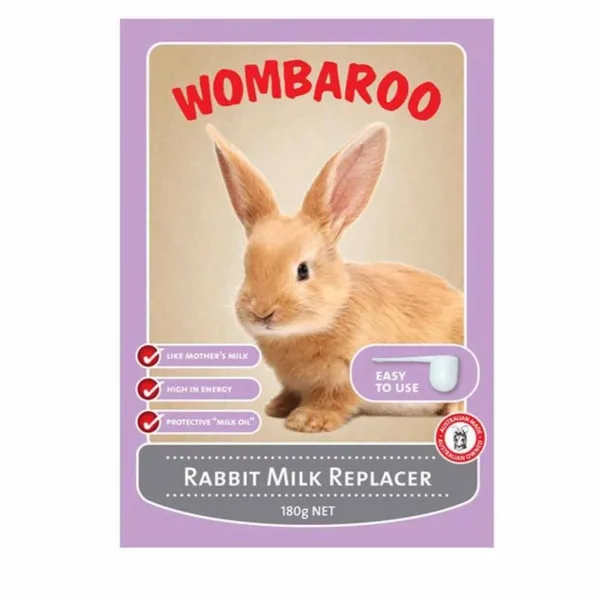
Description Wombaroo Rabbit Milk Replacer 180gWombaroo Rabbit Milk is nutritionally balanced milk substitute formulated…
Wombaroo Rabbit Milk is nutritionally balanced milk substitute formulated for all rabbit breeds. Use for orphaned kits, large litters or when the mother’s milk is limited.
Making up Milk
To make 40mL of milk: Mix 2 level scoops (14g) of powder with 25ml of pre-boiled warm water.
To make 500ml of milk: Mix 180g of powder with 330ml of pre-boiled warm water.
Add half the water to the powder first and mix to a paste. Then add the remaining water and mix thoroughly. Pre-boil the water to ensure it is sterilised. If the water is too hot it can cause the milk to curdle. If it is too cold then it will be difficult to disperse the powder. Wombaroo contains elevated fat levels, so the milk needs to be well mixed to prevent it from separating out. An electric whisk can be used for mixing larger quantities. Milk can be stored in the fridge for up to a day or can be frozen for up to 2 weeks. It is useful to make milk up in larger volumes, and store it frozen in small portions (eg ice cube trays), so that the required daily feed volumes can be easily thawed out. Once thawed out, discard any unused milk, and wash feeding utensils thoroughly.
Feeding
Warm milk to about 35°C. Feed from a syringe or bottle with teat. Rabbit Milk is very high in energy and kits only need to be fed twice a day (morning and evening). Digestive health is aided by “milk oil” fatty acids, which have antimicrobial activity in the stomach.
Toilet young kits manually after each feed. Encourage kits to lap once their eyes open. To avoid dehydration in hot weather, give drinks of pre-boiled water between feeds. Always provide drinking water once kits become active.
Growth
Consistent weight gain is an indication of good health. Weigh kits regularly to verify growth rate and determine feed volumes. Overfeeding can cause diarrhoea.
Weaning
Kits should begin to show and interest in solid food at about 15 days of age. Initially establish young rabbits on hay, grass and leafy green vegetables. Continue to increase solids and reduce milk intake until they are fully weaned at about 5-6 weeks.
Feeding Guide
| Weight (g) | Feed (ml/day) | Weight (g) | Feed (ml/day) | Weight (g) | Feed (ml/day) | Weight (g) | Feed (ml/day) |
| 80 | 11 | 180 | 21 | 280 | 29 | 600 | 50 |
| 90 | 12 | 190 | 22 | 290 | 30 | 650 | 53 |
| 100 | 14 | 200 | 23 | 300 | 31 | ||
| 110 | 15 | 210 | 24 | 320 | 32 | ||
| 120 | 15 | 220 | 24 | 340 | 34 | ||
| 130 | 16 | 230 | 25 | 360 | 35 | ||
| 140 | 17 | 240 | 26 | 400 | 38 | ||
| 150 | 18 | 250 | 26 | 450 | 42 | ||
| 160 | 19 | 260 | 27 | 500 | 45 | ||
| 170 | 20 | 270 | 28 | 550 | 47 |
Ingredients
Whole milk solids, whey protein, casein, milk oil fatty acids, vegetable oils, omega-3 & omega-6 fatty acids, vitamins A, B1, B2, B3, B5, B6, B9, B12, C, D3, E, K, biotin, folic acid, choline, calcium, phosphorus, potassium, sodium, magnesium, zinc, iron, manganese, copper, iodine, selenium.
Typical Analysis
| Protein | 37% |
| Fat | 42% |
| Ash | 6% |
| Moisture | 4% |
| Energy (ME) | 24 MJ/kg |
Dog
Bedding & Litter
Cat
Carriers
Reviews
There are no reviews yet.